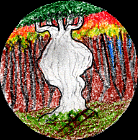
The Forest Temple Island
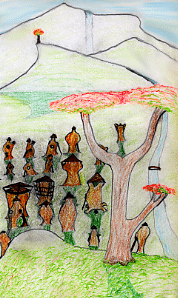
Sangababria is known for its dramatic rolling hills.
Sangababria is known for its dramatic rolling hills.
Climate: Seasonal - Hot summers and cold winters
Geology: Mix of folded metamorphic regions and flat sedimentary strata
Life: Lump tree, tuning fork tree, pod rope tree, singing tringbow
Inhabitants: Bahbers
Music: Warm Afternoon - A song about the warm summer of Sangababria.
Sangababria is a seasonal island that is connected to the southern continent of Stahvoraheeka at low tide. The island's southern end is within sight of Garahkey, and it has a similarly arid climate. The north, by contrast, is much wetter, and temperate deciduous forests are common. Sangababria is known for its eclectic blend of southern cultures, bizarre architecture, sparkling clear canals, rolling hills, dramatic waterfalls, and majestic temples of pale blue stone.
Sangababria was once a shallow sea, accumulating sand and silt deposits. The formation of the supercontinent crushed and uplifted the shallow marine deposits, creating localized metamorphic regions. Subsequent rifting of the continent led to a rise in sea level and created a surge in local volcanism, providing rich soils for what was now a tidal island.
Sangababria was first settled by Bahberik people who were closely related to the stone age people of Tsahngabahb to the north. They built huge temples for the worship of living things, whom they saw as fellow miracles of the evolutionary process.
Sangababria has some of the most spectacular temperate forests in the world, with numerous unusual trees, some of which are found nowhere else. The lump tree is one of the most important to the natives, since its sap-storing lumps can be converted into small houses when the tree dies.

The tuning fork trees of Sangababria have a very vertical central trunk that splits into 2-6 major branches that grow outward at an almost 90 degree angle before growing vertically and branching into almost flat carpets of foliage. Their red bark resembles that of cedar trees. Their leaves are almost always red, much like the leaves of the red maple.
© 2020 Takashi Inskeep. All Rights Reserved.
Please do not download, reproduce, distribute or transmit any of my art in any form or by any means without prior written permission from me (email: takashi[at]tringbowland[dot]com).
If you wish to share them with others, share a link to this page. Thank you.