

A view from the eastern side of Thellahgria
Climate: Tropical - hot, rainy summers and mild, dry, windy winters
Geology: Dolostone caverns and sinkholes
Life: Sinkhole vine, gurble fruit tree, butter-nut tree, arrow leaf tree, pygmy tringbow, giant tringbow
Inhabitants: Tsahngabahbers, Tolakhir, and modern scientists
Music: Lonely Island - A song meant to capture the feeling of Thellahgria
Thellahgria is a dolomite-rich tropical island with numerous caves and passages. It contains one of the few natural entrances to Tolakhir, a cave system that once supported a subterranean civilization. The small island is dotted with tringbow breeding sites, stone age relics, and karst features, including numerous sinkholes. The terraced region within the largest sinkhole, situated at the island's center, supports a variety of micro-habitats, including sparkling blue lakes, bare rocky cliffs, and verdant tropical forests. The central terrace contains a shining cylindrical mansion, the home of a family of wealthy scientists who study the island's history and rich biodiversity. The lower portion of the mansion is held within the rock of an intrusion of granite, suspended high above a yawning black pit. The pit leads to a section of the massive Tolakhir cave system that extends far below sea level. The cave region is kept dry by an array of extremely powerful pumps, allowing for exploration below the surface.
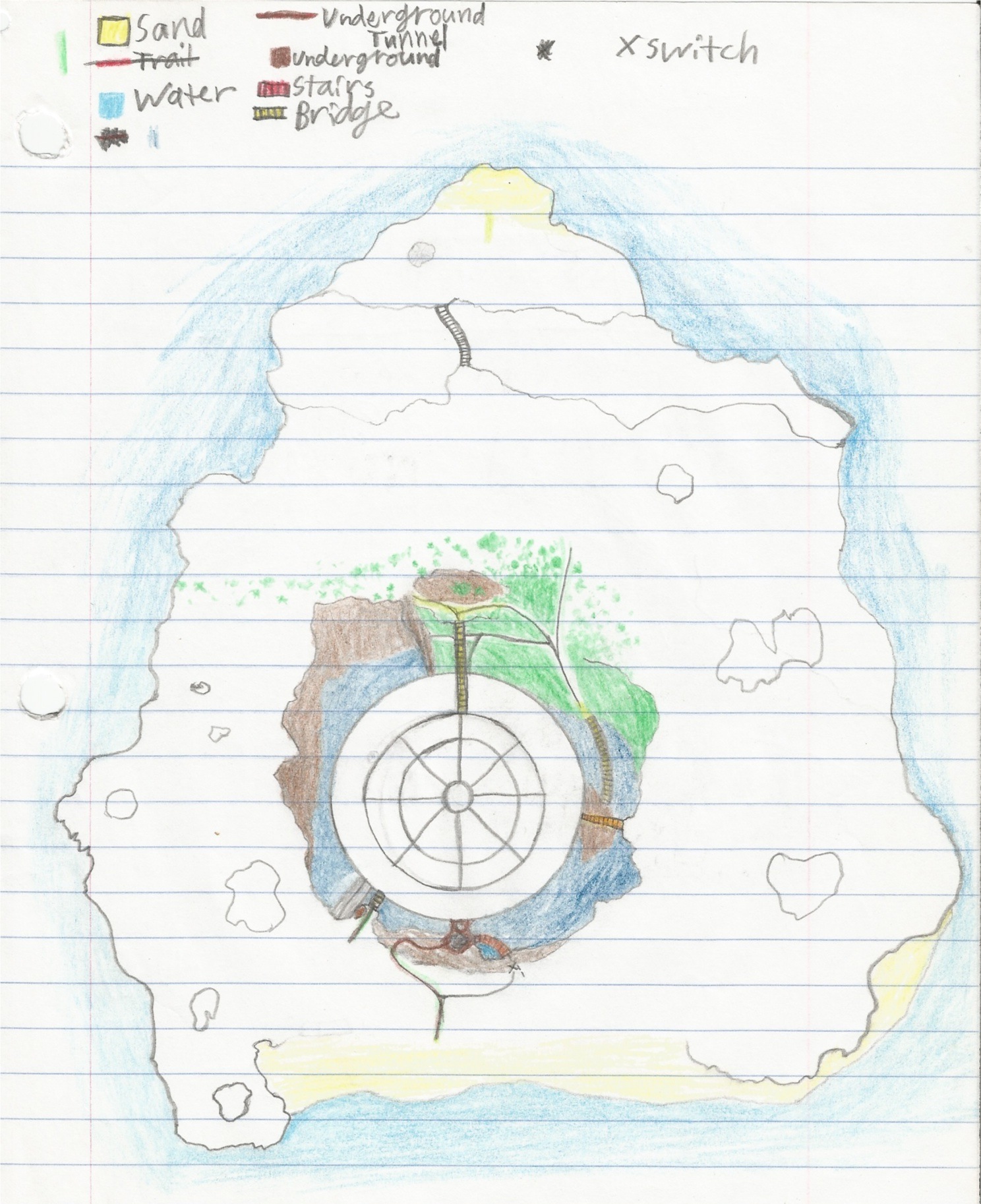
A simplistic map of Thellahgria
Thellahgria formed when a drop in sea level exposed a limestone region from an ancient reef. Much of the limestone eroded away, leaving a hill of more durable dolostone behind. Over time, some of the dolostone also began to dissolve due to infiltration of rainwater, thus forming an elaborate network of dolostone caverns which intersected the larger Tolakhir cave system. Some cave rooms grew so large that they became unstable, thus forming the deep sinkholes found throughout the terrain. The continuing erosion also exposed an outcrop of a granite intrusion left behind from when heat from the more iron-rich magma of an ancient hot spot melted the continental crust and forced it upward through the limestone layer above.
Music: Caves of Thellahgria - Inspired by Thellahgria's dolostone caverns
The retreat of glaciers initiated by an asteroid impact near Avyaira's south pole caused a rise in global sea level, inundating the land surrounding the dolostone hill and turning the hill into the island of Thellahgria. This transgression also flooded the local section of Tolakhir, cutting it off from the main Tolakhir city at high tide.
The island of Thellahgria is historically significant, because its entrance into Tolakhir served as a crossroads between the Tolakhir culture and the native culture of the Tsahngabahb region back when Thellahgria was part of the mainland continent. The Tsahgabahbers and Tolakhirs traded many foods and works of art, and influences between the two cultures are evident throughout the island.
The rise in sea level caused Thellahgria to be cut off from Tolakhir at high tide, though the old section of continent re-emerges as a barren tidal flat at low tide. The sea level rise slowed trade with Tsahngabahb and made it considerably more dangerous, which was one of the many factors contributing to the collapse of the Tolakhir civilization.
Music: Armored Door Caverns - Theme of ornate gateways to hidden tunnels

A view of Thellahgria's rocky peninsula with structures built by descendants of the Tolakhir.
Some Tolakhir people chose to leave the main city cavern and take up residence on the dolomite islands of Thellahgria, Jahreen, and Tsahngabahb. These islanders retained their love of underground environments, often living in fortresses and bunkers built within the grey dolostone caverns. They also retained an alliance with the stone age people native to the islands, an alliance that would be crucial in defending from attacks by the remnants of enemy forces. Escape from their enemies was the reason for establishment of Tolakhir as an underground civilization. To protect their homes in the island caves, the new cave people sealed thier refuges behind ornate armored doors. Guerilla warfare persisted for several years until the attacks ceased.

One of the armored doors covering an entrance to Thellahgria's cave system
After the fall of Tolakhir and the migration of the stone-wielders to the current Tsahngabahb and Jahreen archipelagos, a group of wealthy scientists took up residence on Thellahgria. They built a high-tech cylindrical mansion that served as a home and scientific facility as they took it upon themselves to study the island's natural and historical significance. The science team was led by Princess Tsevha, the last surviving descendent of the high queen matriarch of Tolakhir and current chairwoman of the Tolakhir Survival Committee.

The central mansion is home to the scientists who study the island. It contains living quarters, a library, a laboratory, and a greenhouse/observatory.
Due to its relatively recent isolation, many of the island's species are unique, though they are closely related to species from the mainland. This provides a unique opportunity to study the nature of biological evolution on the moon of Avyaira.
The island boasts a rich diversity of flora. The main plateau is covered with prairies of grass and fern-like photomotes. Vines hang down into the deep sinkholes dotting the island. Trees bearing sweet, orange gurble fruit are abundant, as are the fat-rich butter-nut trees. Arrow leaf trees make up the bulk of the lush forests within the central sinkhole.
The sinkhole forests play host to the pygmy tringbow, a year-round resident of the island. Pygmy tringbows are about 5 centimeters, or 2 inches, wide from wing tip to wing tip, much smaller than their common grey cousins. They live in social nesting colonies and eat a variety of plant and animal-like lifeforms. Their distinctive squeaking calls can be heard throughout the daylight hours, falling silent with the coming of night.
White, furry squeakmonks scamper up and down the rocky cliffs in the lake terrace regions. They resemble large white rodents with cat-like tails. The almond-shaped upward protrusion of thier heads betrays their close relation to tringbows. The sturdy head crest contains resonant chambers for amplifying the squeakmonk's call. Like in tringbows, the crest also contains a head light, a large patch of cells capable of glowing in various colors. Squeakmonks use thier head lights and loud chirping calls for communication. They live in small groups consisting of family or friends, and they sleep in hidden crevices within the cliffs.
At certain times of year, the island is visited by giant tringbows, as Thellahgria is one of their many breeding sites. When the time is right, they gather and nest on the green plateau that makes up the majority of the island's surface. They dine on the surrounding ocean's rich bounty, using their 12 meter wingspan to glide on the near constant wind that sweeps the island. Thellahgria is an ideal location for them, because their size requires them to take off by leaping from the high dolostone cliffs that border the plateau.
© 2020 Takashi Inskeep. All Rights Reserved.
Please do not download, reproduce, distribute or transmit any of my art in any form or by any means without prior written permission from me (email: takashi[at]tringbowland[dot]com).
If you wish to share them with others, share a link to this page. Thank you.